The Impact of Visual Models for Your Business

Imagine walking into a retail store to buy a puzzle. You think you know what you want, but you’re not entirely sure. You’re keen to hear from a Puzzle Expert, someone who has experience and understands this world more than you.
A salesperson eagerly directs you to a room where there are puzzle pieces scattered all over the floor. She tells you that when they’re all put together, a fabulous picture will emerge, one that you’ll absolutely love and that’s likely to change your life and she’s happy to help!
But there are no obvious guidelines to get you to this amazing result.
There's no box.
No image to follow.
No instructions.
Just the enthusiasm of the salesperson and their reassurance that this has been done “hundreds of times before and you just have to trust the process”. Oh, and invest a chunk of time, energy, and money.
That would be pretty daunting, wouldn’t it?
We all need to see what we’re aiming for
If you’re a puzzle lover, you already know how satisfying it is when the picture you're working towards gradually reveals itself. Your experience tells you it becomes easier to take action as more pieces are put in place, how your confidence grows as your clarity builds.
Providing your potential clients with visual models works in much the same way.
When you create a visual model, you're essentially putting a picture on the outside of the box. You're identifying, elevating, shaping, and sharing what already exists in your business - your strengths, methodologies IP, and expertise, and presenting them clearly and compellingly.
This is just one of the four strategies from my Authority Initiatives© approach. These initiatives, as the name suggests, help deepen and strengthen your authority and credibility in the market.
Visual models highlight the gaps to close
One of the most powerful aspects of visual models is how they highlight gaps. They orientate us, giving a clear, visual representation of where we currently are and where we want to be. This realisation can be equally reassuring, motivating, and encouraging – “I know where I am, where I want to go, and how to get there!”.
When I wrote my book in 2020, I captured and communicated some of my key ideas visually in models.
That's one below - a specific version of my "Next Chapter Model of Change" showing the Decision stage that takes you out of the Deliberation Zone and into the Doing Zone.
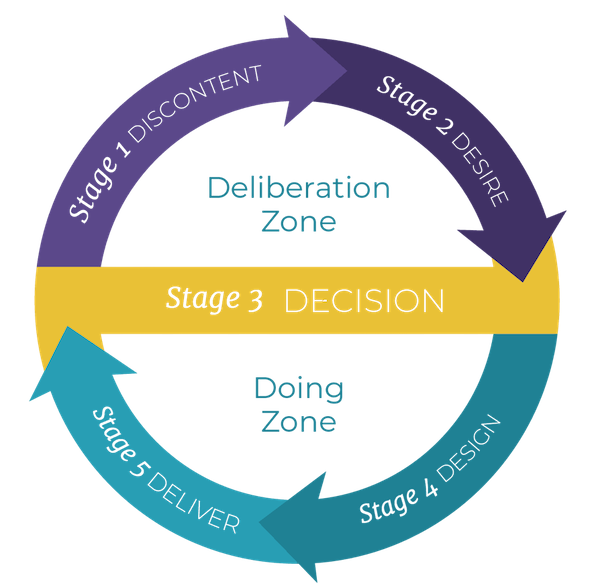
Readers and prospects said they could “see where they were” in the models and I began incorporating them into my discovery calls. Today I have many new models that I reference and illustrate and the connections they create are even stronger.
One of my clients, Sarah Gillis, the Founder of Aspire Australia, found the same thing. The 7-Step Migration Action Plan (MAP) visual framework we created years ago is still highlighted on her website. It continues to simplify and clarify the complex migration process for her clients, showing step-by-step what they can expect to experience.
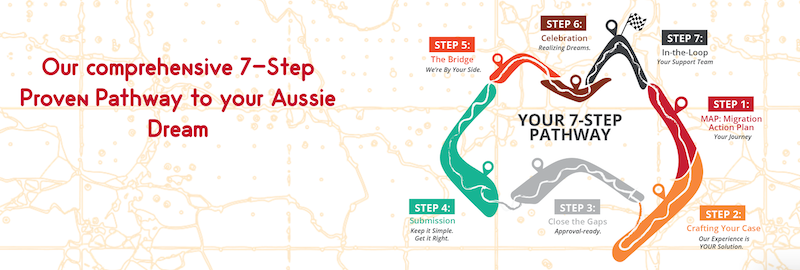
It also further reinforced Sarah's authority and credibility – her potential clients knew they were in experienced hands.
Building Credibility and Authority
Visual models demonstrate you have a proven process, not just a collection of fabulous, but disconnected, ideas.
For Catherine McCoy, a wonderful naturopath with 18 years of experience we developed "The Fatigue Solution". She already had a passion for this area of her work, so I simply focused on consolidating her proven expertise in tackling fatigue.
Our Authority Initiative work involved 3 foundation steps:
A Visual Model
Naming her Service
Defining the likely treatment phases
And then the marketing element – here’s an example of her revamped LinkedIn profile below. I distinctly remember when we found the perfect image to encapsulate the feelings of her ideal client – we were working together at one of my Business Retreats in Kangaroo Valley and thought it was distinctively, hilariously perfect!

These actions, coupled with the brilliant results Catherine delivers (which I can vouch for as I've experienced them), helps her potential clients to self-identify as NEEDING the Fatigue Solution when they reach her website and this increases their readiness to invest in her services.
Creating your visual models
How do you get started on creating your own models and weaving them into your overall positioning and marketing strategy? Notice the plural there, as you'll likely have more than one.
And, if you're sparky-brained, you might have dozens of brilliant frameworks living in your head…struggling to get them onto paper in a way that feels clear. Visual models work beautifully with the way our brains connect dots that others can't see. The challenge? Not creating 17 different models at once. Start with ONE core framework that captures your signature process, then build from there.
Here are some steps to get you started on your first one:
Identify the bookends of your service: where are clients at when they come to you, and where do you take them to?
Map your process: What steps do you *typically* take clients through on this journey?
Choose a visual shape that fits: Which is the best option/s to communicate progress, clear steps, milestones, or phases? Flowchart, Venn Diagram, Matrix, Pyramid, or something else?
Claim and name: Both the steps and the overall concept. Keep it simple - "death by text" in models is almost as bad as "death by PowerPoint"
Build it with your brand: Visit Canva, find a template, and have some fun!
Don’t offer your potential clients an array of jigsaw pieces and no box – gather your thoughts and add an extra layer to your positioning and authority with visual models.
They really do make a tangible difference in your business.
Creating visual models is one of my specialties - my sparky brain excels at seeing the big picture, isolating the most important elements, and connecting all the dots into something clear and compelling. I've created dozens of Differentiation Models©, Signature Systems, and Offer Staircases with clients over the years. If you'd like help clarifying your expertise into a visual framework that strengthens your authority, let's have a Catalyst Conversation to explore what's possible."
* The asterisk is there because we're creating a framework, not a formula. Please don't subject your client to a straitjacket!