Why your wins don't feel like wins when you have ADHD

Earlier this year I finished something I'd been first thinking about, and then finally working towards, for months - the update of my book to incorporate the Sparky Lens perspective on starting, growing, and running a business that was missing when I first published it in 2020.
This was the kind of milestone I'd have insisted a client stop and properly savour. To bask in the warm feeling of accomplishment and pride. The hit of I did that.
But when the boxes of the freshly printed edition arrived, although I did feel a small fizz of delight, the main emotion was relief - I'd ticked the box and the pressure was off. Within a day or two I was already focused on the next thing, the accomplishment filed away as though it had never mattered much at all.
If you're sparky-brained, I suspect you're familiar with this particular flatness - it's one of the most common, least talked about experiences of having ADHD in business. You cross a finish line you've been striving towards for weeks, and instead of satisfaction, you feel a strange sort of…. not a lot. And maybe you even interpret the lack of excitement as proof that it wasn't really that much of an achievement anyway.
That's not the truth - your achievements, my achievements deserve to be celebrated. There’s a very good reason why their impact doesn't always hit strongly or last long. There's a mechanism at play underneath, and once you're made aware of it, a surprising amount of your business behaviour starts to make a different kind of sense.
The ADHD reward that doesn't fire
When you have ADHD, the dopamine reward that's meant to fire when you complete something often doesn't - and even when it does, it doesn't accumulate into a lasting sense of capability. Researchers call this the dopamine transfer deficit. The win arrives, then slides straight off, which is why finishing something big can feel like relief instead of pride.
A neurotypical brain tends to release a little reward of dopamine when a task is completed, a small internal well done that lands as genuine satisfaction. And that satisfaction does more than feel good in the moment. Over time it attaches itself to the effort that earned it, quietly accumulating into a background sense of I'm someone who gets things done, I can trust myself to deliver - so the win isn't only felt, it's banked as evidence for later.
Our ADHD-wired brain is chronically short on dopamine, so that reward often doesn't fire strongly for us when we reach a finish line. And even when it does, it tends not to transfer and accumulate the way it's meant to. The win arrives, and then is sort of taken for granted, rather than being deposited into a growing story of what we're capable of.
There's a second half to this that took me longer to understand, and it's the one that really explains why the self-doubt is so stubborn. The same system that under-registers our wins tends to over-register the knocks. Praise slides off like teflon while self-criticism of what didn’t meet our often sky-high expectations of ourselves, sticks like velcro. So the ledger we have about ourselves ends up lopsided - loaded up with every time we tell ourselves we weren’t up to scratch, and strangely light on all the things we have done well. When you know this, it’s not so surprising that we can tend to write off genuine, significant accomplishments as "not that special, not that great…anyone could have done that…". It's why so many of us don't feel proud of our accomplishments, even the big ones.
Relief is not pride - and it's not a building block
Relief and pride are different experiences.
Relief has a tendency to empty you out. It says thank god that's over. In contrast, a sense of pride fills you up - it provides future fuel for your next endeavours, because it says look what I'm capable of. When your finish lines keep delivering relief instead of pride you can end up running your whole business on an empty tank, feeling depleted rather than buoyed by your own results.
The second hurdle: when important business tasks feel impossible
Big projects aside, when we have a reward system naturally running low on dopamine, the ordinary, important, but not that interesting or unglamorous parts of running a business can be even harder to tackle. Our interest-based nervous systems can fall into a comatose state when we contemplate the "need to do" activities that business demands!
Add in the "now, not now" time perception quirks that we commonly experience and we hit another challenge. Although we genuinely understand that tasks like following up a warm lead or promoting an event that's taking place next month are important, it can still be genuinely hard to take action until it becomes urgent. That's not a character flaw or a discipline problem, it's a neurological reality that no amount of "just be more disciplined" is going to solve in a sustainable way.
TBH, that's one reason why I'm a fan of our adopting Dedication over Discipline. Dedication has the same impact as discipline - I show up and take action. But the fuel comes from a different place. Not obligation. Not shoulds. Not comparison. It comes from a focus on contribution. Dedication anchors me back into WHY I'm in business, and that makes a world of difference because I’m wildly interested and inspired by my purpose, and so can far more easily find the focus and energy to tackle the more mundane actions I need to take.
Our interest based nervous system and dopamine deficiency also explain the pull toward the new and shiny. When everyday rewards are muted, our brain goes looking for stimulation - the rebrand, the reinvention of the perfectly good offer, the rabbit hole of a new piece of tech, even a NEW NOTEBOOK all deliver a dopamine burst that the steady, compounding work of consistency and rhythm just can't compete with. So the very things that help us build our business, such as staying with one positioning long enough for it to pay off, is the very thing our reward system under-rewards, while novelty over-delivers.
How this shows up in your business
You over-deliver. You keep adding, refining and polishing, chasing a sense of enough that your reward system is never going to hand you. If finishing doesn't feel like anything, some part of you reasons, then perhaps I simply haven't done enough yet. So you do more, and more, and the goalposts keep moving.
You undercharge. A sale, a booking, a yes, these are meant to register as evidence that your work is valuable and so are you. When that evidence doesn't land, your pricing stays tethered to an old story about not-quite-being-enough rather than to the real value you deliver. The numbers on the invoice never quite update the belief underneath.
You assume your audience is as OVER your offer as you are. I think this is one of the most costly impacts. Because your brain has long since stopped finding your core service novel, it feels stale and over-familiar to you. And so you turn away from the thing - you stop promoting it, stop talking about it, and pour your energy into inventing something new, while an audience that has barely heard of the original offer, or would genuinely love it, misses out. Your boredom is not their experience, but the reward gap makes it really hard to recognise that.
Your sense of agency and capability never compounds. Every win is meant to acknowledge I did that. I can make things happen. I can trust myself. Over time those deposits are supposed to build into a strong sense of your own capability. But if they slide off like teflon, they can't compound. And because the difficult or disappointing moments did stick, the story you carry keeps its thumb on the scale, tipping it towards doubt, no matter how much evidence stacks up on the other side. So you can have ten years of genuine results behind you and feedback that underpins it, but still feel like a rank outsider who has to keep improving. This is a big part of what keeps so many of us stuck in Perpetual Potential, capable and committed, yet never quite able to see, own, and embed the reality of our ability.
What actually helps: how to bank your wins
You can't wait for your brain to hand you the satisfaction on its own, it needs help. So, banking your wins deliberately is an important Self-leadership practice.
Catch your wins - resolutely refuse to let them slide past. Regularly refresh your Fabulous File (the visual display of your accomplishments)
Name the win out loud. Tell someone about it. Document it. Sit in it for longer than might feel comfortable, precisely because your instinct is to rush past it towards the next thing. Plan a specific reward.
This is how you build Future Fuel - energising yourself to keep moving forward in business, especially important when things are hard. I'm big on this - the image below is one of the tools in my Planning Suite and you can see how Future Fuel is baked into the top row of a weekly plan. Us sparkies NEED this!
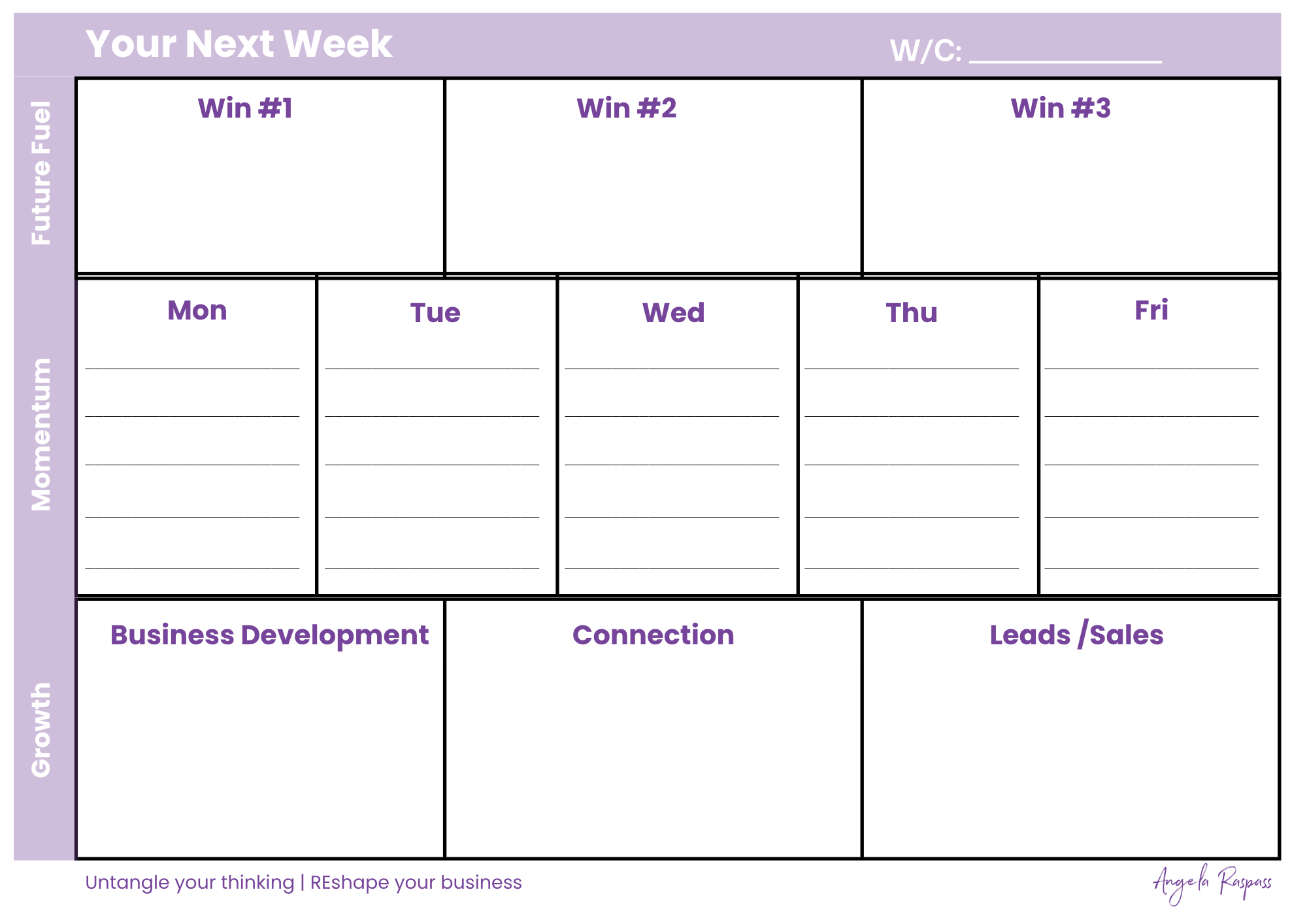
Self-leadership work is as important as good business strategy. A key principle from my framework is in play here - emotional dexterity, the skill that helps you notice the flatness and recognise, challenge, and replace the story of "X doesn't really count" rather than automatically believing it.
The next time you catch yourself certain that your audience is bored of your best offer, or reaching for a shiny new idea before you've let the current one land, pause and ask whether it's really them who's over it, or just your reward system doing what it does. More often than not, the answer will surprise you.
If your wins keep sliding off, and you can feel that no amount of achievement ever quite updates the story you carry about yourself, that's a piece of the untangling work we do in the See it and Own It components of The REwire Method™ before we dive into business strategy.
If you'd like to explore what that could look like for you, let's have a conversation.
A note on the science: If you'd like to go deeper: the interest-based nervous system is Dr William Dodson's term, his article "Secrets of the ADHD Brain" is the best place to start. The dopamine transfer deficit, how the reward signal that's meant to attach to our efforts fires differently in ADHD, comes from researchers Gail Tripp and Jeff Wickens, in this paper. And self-efficacy, the idea that our belief in our own capability is built by banking mastery experiences over time, comes from psychologist Albert Bandura and is well-explained in this overview from the American Psychological Association.