What "sparky-brained" really means - and why I used it before I knew I had ADHD

There's a word I use all the time. You may have noticed it.
Sparky-brained.
I use it to describe myself, and many of my clients, who seem to share a particular flavour of being - fast-thinking, fast talking, fast moving, constantly idea-generating doers, life-long learners, who feel deeply, are committed to meaningful, impactful work and enthusiastic about… well, lots of things!
And somehow still struggling to get the traction that all of that energy should, by rights, produce.
But sparky-brained is not my shorthand name for ADHD.
It came before the diagnosis. It came before I even suspected one was waiting for me.
And it might describe you, whether you're an established entrepreneur, business owner, consultant or practitioner who has simply spent years quietly wondering why, despite working hard and caring deeply, the progress you know you're capable of seems to come so much more easily to others. Whether you have a diagnosis, suspect you might, have actively decided not to pursue one, or have no label at all - just that persistent, nagging sense that something in the equation isn't adding up.
The picture I grew up with about ADHD
I'm a Gen X woman. And like most Gen X women, the mental image I carried of ADHD for decades was very specific: a fidgety boy, probably primary school age, unable to sit still, disrupting the class, driving his teacher crazy, and likely his classmates too.
The follow-up image I held (equally wrong) was the dismissive thought I had about one of my Bonus Boys (my husband was a package deal, he came with two young boys from his first marriage). When I was told the younger of the two had ADHD my thought was: "Well, he can focus on video games for hours, so there's clearly nothing wrong with him - it's a behaviour thing."
I cringe now, recalling that I thought and honestly believed that.
I had equally no idea that ADHD in women and girls often looks completely different. That the hyperactivity is often entirely internal - a relentless, invisible hum of thoughts, ideas, feelings, and self-criticism that nobody else can see. That "doing well at school" is not contradictory evidence. That there is often a high cost for that "success", exhaustion, working twice as hard to mask and compensate and hold it all together, driven by a less than encouraging inner voice demanding you be better, always better.
I didn't know because the world didn't know. And so the idea that I, a seemingly capable and articulate businesswoman, could have a core of ADHD never crossed my mind.
How sparky-brained came first
Long before any of that changed, I had already started using the expression sparky-brained to describe myself.
It was the best description I had for my endless supply of ideas, popcorn brain style, how I could connect the dots others seemed to miss. The content calendars begun with great intentions and then quietly dropped when another new solution caught my eye. And how I genuinely, wholeheartedly believed that THIS time THIS planner was the answer to my lack of coherent systems and that THIS new service was going to be an absolute rip-roaring success…. Before I lost interest and came up with another one, often just weeks later.
Sparky-brained felt like the perfect description. It felt like it held the confounding package of gifts and challenges I experienced, and that I also noticed in so many of the women I worked with or met in the entrepreneurial space.
I tried to ignore, however, the constant looping thought - I know I'm capable of more than this, why can't I break through? That feeling of perpetual potential didn't feel very sparky at all.
The reckoning that changed everything
I was 53 when two things happened in close succession.
First, a close friend with a late-stage ADHD diagnosis said, gently but repeatedly, that she thought I might want to look into it. I resisted because we're quite different - I didn't recognise myself in her experience and let the idea drift.
Then my daughter, who was nineteen at the time, was diagnosed.
As I began to read about what this entailed, motivated to understand her experience and support her, I remember sitting back in my chair, stunned by the shock of recognition.
ADHD for women looked and felt like my experience.
The emotional highs and lows. The cycles of overthinking. The impulsivity. The distractibility. The time blindness. The perpetual self-doubt, regardless of experience and feedback.
I recognised myself on almost every page.
When I tentatively said to my daughter that I thought I might have it too, she didn't look surprised. She looked at me and said:
"D'oh. Why do you think it took so long for me to be diagnosed? You thought I was normal."
Ouch.
She was right. When she'd mentioned in high school that she thought she might have ADHD, I dismissed it. She was doing well academically. Clearly fine.
Yes. But at what cost? High anxiety. Constant striving. So many teacher meetings and psychology appointments, and not one person, not one, ever raised the possibility of ADHD, because we were all still operating from the same outdated picture.
The shame of that realisation was significant. Even though I could see the logic, if experts hadn't spotted it, how could I really expect to have done so myself? Mother guilt tends to defy logic, doesn't it? But the collateral damage of a paradigm that has failed girls and women for generations needs to be acknowledged and addressed.
The grief that comes with a late ADHD diagnosis
Post-diagnosis can be a complicated place.
I mapped the emotional cycle I went through and that I've witnessed in clients and others into what I call the Late-Stage ADHD Diagnosis Cycle. It moves through surprise, relief, sadness, anger, acceptance, and adjustment. Not always in a linear way, and seldom quickly.
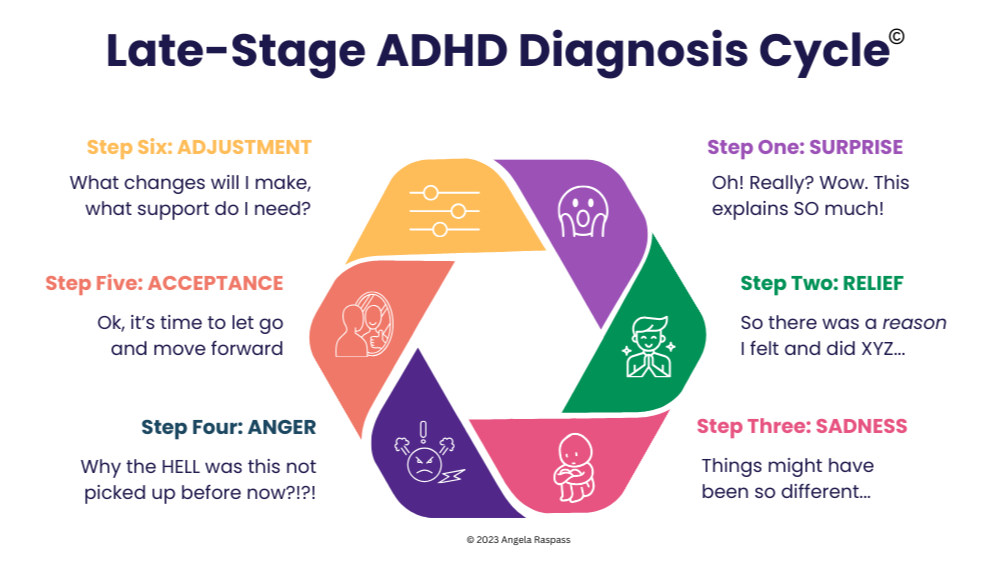
The sadness and anger phases, in particular, deserve more honest conversations than they tend to get.
For those of us who find out in our forties, fifties, or even later, there is a lifetime of self-recrimination to revisit with new understanding. A path littered with the emotional debris of why can't I just... and everyone else manages to... and what is wrong with me?, all of which now has an opportunity to be reframed, that's true.
But reframing alone doesn't instantly dissolve it.
I think of that little Angela in the old school reports: Angela needs to remember she's not the only one in the classroom. Angela needs to think before she acts. Angela will see better results when she is more organised. She was curious, exuberant, full of ideas, and she spent years learning to rein all of that in.
Learning that she was too much.
Learning to seek approval.
Learning to fit in.
Trying to shrink to avoid the relentless bullying but never quite finding the right combination of behaviour and being that was acceptable.
Little wonder my sense of self-worth took such a battering.
There was a lot of grief to process before self-compassion could surface, and I was very grateful to work with a therapist who had a great understanding of the multifaceted impact of a late-in-life ADHD diagnosis.
The piece I don't talk about as often
There's something else woven through this story that I want to name clearly - something the research is unambiguous about, and that my own ADHD diagnosis finally helped me understand.
The link between untreated ADHD and addiction is very strong.
Undiagnosed and untreated ADHD can drive the reaching for something that quiets the noise, soothes the dysregulation, provides the dopamine hit the brain is perpetually seeking, and that's not a moral failing. It's a neurological one.
I also believe that the perpetual feeling of not belonging, of there being something inherently wrong with you, is a strong shame trigger. And what soothes shame? A whole host of addictions. Again, that's not a moral failing. It's the human condition to want to soothe pain.
I'll be twenty years sober in November, so things did eventually turn out okay for me in that respect. But understanding the connection between my undiagnosed ADHD and my earlier relationship with alcohol has been an important part of my own healing and self-leadership journey.
If addiction is a part of your story, please know you are not alone, that support is available, and most importantly, you are not a bad person who needs to become good.
What sparky-brained means now
So where does that leave the term?
Sparky-brained has evolved for me. It started as a description and has become something closer to a philosophy.
It describes a brain style, not a diagnosis. It encompasses many of the traits, tendencies, and thinking and working styles associated with ADHD. It means there are likely easier ways of working that align more with who and how you are, and exploring what this looks like for you, so you can step out of the loop of perpetual potential you might feel you're stuck in.
It includes women who suspect but haven't pursued assessment. Women who know something is different about how they think and feel and work, but don't have or want a label for it. Women who are beginning to realise that the gap between their capability and their traction isn't a character flaw, it's more likely a mismatch between the way they're working and the way their brain actually operates. Or perhaps more clearly, the way they think they should be working and what will actually work for them.
So it includes women who have spent years, as I did, trying to build a business using systems, structures, and strategies designed for a different kind of brain.
You weren't doing it wrong.
You just needed a different map.
What this looks like in business specifically
Because my personal story is only half of it.
The other half is what happens when a sparky-brained woman tries to build a business using tools, systems, and strategies designed for a completely different kind of brain.
I know this intimately, not just from my own experience, but from watching it play out repeatedly in the women I work with (many that I now recognise as sparky-brained entrepreneurs and business owners). Some of the classics include:
The new planning system that works beautifully for three weeks and then quietly dies.
The content calendar begun with genuine commitment, and is then abandoned because it just doesn’t work in reality.
The new idea that hijacks everything - excitement peaks and captivates and then the novelty wears off before the traction arrives.
The confidence that seesaws between I've absolutely got this and what on earth was I thinking? (sometimes within the same afternoon).
The comparison trap that sucks you in quicker and impacts you more deeply than it does others.
The to-do list that grows faster than it shrinks, because everything feels equally urgent and equally interesting, and your brain simply will not easily cooperate with prioritisation.
None of these are character flaws, lack of discipline, or insufficient commitment to your goals.
It's what happens when a sparky brain tries to operate using someone else's manual!
The shift, and I say this having lived it, comes when you stop trying to fix yourself and start designing a business model and marketing actions that are actually built around how you think, work, and generate energy. Different rhythms. Different structures. Different ways of making decisions and maintaining momentum. Strategy that works with your wiring, not against it.
That's the work I do with my ADHD Business Coaching clients - and if you'd like to explore the landscape first, the ADHD in Business page on my site is a good place to start.
You don't have to have an ADHD diagnosis to be a part of my world
This is perhaps the most important thing I want to share.
I’m not diagnosing anyone. I'm not a psychiatrist. And I strongly believe that the decision to get a formal assessment, or not, is personal, and there’s no right answer.
What I do know is if something in the thoughts I’ve shared here has had you nodding (or maybe even exhaling) because it’s describing your experience, that recognition matters.
You’re not too much. You’re not scattered, or undisciplined, or lacking the willpower that everyone else seems to have. You don’t need to tell yourself that “you’re not cut out for this being in business for yourself caper”. (Fun Fact: approximately 29% of entrepreneurs report having ADHD, and that’s significantly higher than the 2%–5% prevalence in the general adult population. Apparently studies suggest sparkies are 3 to 500% more likely to start their own business, because we need autonomy, creativity, and variety).
So, you are not someone who just needs to try harder or find the right planner or commit more firmly to the system.
You’re wonderfully sparky-brained! And your business, your self-trust, your sense of what's possible - all of it can be retro-fitted around the new reality a late stage diagnosis (or recognition) provides.
That's the work I do. Not just strategy, but self-leadership - the inner and outer recalibration that allows a sparky-brained businesswoman to build something that genuinely works for her brain, her energy, and her life.
If you'd like to explore what that looks like in practice, my book Your Next Chapter is a good place to start.
I wrote the original edition during the 2020 COVID lockdowns, before I had any idea I had ADHD. I've recently revised and updated it, and the new edition opens with a Preface called Through a New Lens, essentially the story of returning to my own book and seeing it differently once I understood my brain. The original business building frameworks, tools, and chapters are all still there. But woven through them now is much I've learned about what it means to build a business as a sparky-brained woman: the energy patterns, the non-linear path, the self-doubt that cuts like a knife, and the self-leadership practices that actually help.
If something in this article resonates, I think you'll find the book meets you exactly where you are - you can find it here.
And if you're ready for a conversation about your own next chapter, my ADHD Business Coaching work is designed specifically for women like us.
You've been perpetually almost there for long enough.