When "Yes" is a Problem: Decision Filters Change Everything

If you're a woman building your own business, consultancy, or practice, you know the weight of every decision. Each choice shapes not just your current reality but your future - Your Next Chapter.
And yet, how many times have you found yourself feeling resentful, drained, or frustrated by decisions you made in the past? Maybe you said yes to something that didn't align with who you truly are or where you're heading, and now it's taking a toll on your energy and enthusiasm.
You're presented with opportunities constantly: new projects, client requests, invitations to events, and chances to collaborate. Without a clear way to evaluate them, it's too easy to say yes for the wrong reasons - FOMO (fear of missing out), a bias for action, people-pleasing tendencies, or simply feeling pressured in the moment. And that's how you find yourself stretched thin, off-track, resentful, and wondering, "Why did I agree to this?" and "How have I got myself here, again?"
At my business retreat in Kangaroo Valley last week, something rather remarkable happened that reminded me just how powerful a simple tool can be when you're navigating these challenges.
The Pattern That Keeps Showing Up
I was facilitating a planning session and explaining a tool I recommend to all my clients when one of the women there - let's call her Sam - gave the perfect example of its value.
Sam shared the list she'd created a couple of years ago after one of our mentoring sessions, after recognising there were some particularly tough parts of her business where she felt burnt out, dissatisfied, and resentful of certain areas of her client work.
"This changed everything," she said. "I still use it all the time."
It was her Decision Filters.
I work with a lot of very talented, capable women who often have a bit of an Achilles heel when it comes to saying yes to things too quickly for lots of perfectly understandable reasons.
Not wanting to let someone down. Thinking, "I should probably do this." Fear of missing out. Excitement about a new idea. Or just that bias for action—doing something feels better than doing nothing, even if that something pulls you off track.
Sam's scenario was familiar to me because I'd seen it in other clients and also in myself. We can find ourselves drowning in commitments that looked good on paper but leave us feeling drained and resentful. Or running eagerly down rabbit holes before checking where they lead.
When we fall into these traps, our business ends up running us, not serving us.
The Glass Blinkers Approach
I often suggest my clients "put on your glass blinkers"—that way, you can choose to see what's happening in your market, but you can avoid being hijacked left and right, and stay focused on your own work.
Decision filters are like that, but for opportunities. They help you pause and ask: "Does this align with who I am, what I value, and where I want to head?"
How Do You Create Your Filters?
Let me share another example - a succinct list for my client Elodie, developed through a pretty simple process during a strategic planning workshop.
We started by confirming her values, the ones that she wants in action in her business, and then by looking at her past projects—both the ones that had energised her and the ones that had left her feeling flat or resentful.
Patterns started to emerge:
The good stuff that aligned with her values involved fair pay, clear expectations, clients who valued her input, and freedom to do her work without someone hovering.
The draining, non-aligned stuff? Micromanagement. Late payments. Dismissive attitudes. Last-minute chaos.
From those reflections, we built five filters:
Reciprocity - She needed fair compensation and mutual value exchange
Resources - Clear scope, timelines, and support
Respect - Her expertise valued, not taken for granted
Relationship - Collaborative, human-centered dynamics
Autonomy - Freedom to shape the process without micromanagement
We also identified her "Instant No's", the non-negotiables that are a part of this chapter of her business (they may change in the next):
❌ Unpaid work
❌ High-conflict environments
❌ Rigid micromanagement
We created a simple table with "What I need" and corresponding "What I won't accept" columns underpinned by these "Instant No's."
Here's what it actually looked like - the snapshot from our work in progress:
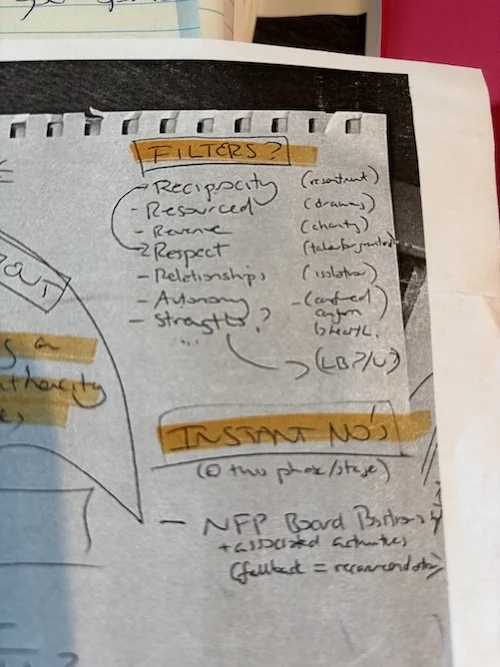
We spoke about the effectiveness of this list in her final mentoring session, some 8 months after that workshop, and she remained clear and confident in her discernment, anchored by this simple guidance tool.
Your Own Filter Themes
Your decision filters will be unique to you, but they might include themes like:
Autonomy | Collaboration | Creativity | Clarity | Flexibility | Mutual respect | Recognition | Innovation | Spaciousness | Well paid | Aligned values | Trust | Emotional safety | Growth potential | Fun! | Shared vision | Meaningful work
Start with 3-5 that matter most to you and this chapter of your business.
A Note for My Sparky-Brained Friends
If you have a sparky brain, you might be nodding along to all of this but also thinking, "Yeah, but..."
I know—I really do! Our sparky brains love novelty. New projects sound fascinating. And collaborations? So much FUN! That speaking opportunity? I'm all in!
The dopamine hit of something new makes it really hard to pause and evaluate whether it's actually a good fit.
And if you're also someone who genuinely wants to help people (yes, lovely people-pleasers, I see you too), the perfect storm happens. You say yes because it's exciting, you say yes because you don't want to disappoint anyone, you say yes because you want to do the right thing... and before you know it, you're overcommitted. Groundhog Day descends...
This is where having your filters written down becomes particularly helpful. They're the pause button between "Ooh, shiny!" and "Wait, let me check..."
They help you ask: "Yes, this sounds exciting, but does it actually meet my needs? Do I have the capacity? Are any red flags present?"
They're not about killing your enthusiasm. They're about channeling it toward things that will actually serve you and your vision for your next chapter in the long run.
I'm not saying no to everything - where's the fun in that!? But I am saying discernment is a vital business skill, and Decision Filters help.
What Happened for Sam
When Sam shared her filters at the retreat last week, she told us she'd turned down opportunities over the past two years that would have left her drained. She'd held her price points. And she'd confidently said yes to work that genuinely energized her.
"My business finally feels like it's serving me," she said.
That sparked a deeper conversation about decision filters at the retreat, and the other women were eager to create their own.
The Simple Process
If you're curious about creating your own decision filters, here's the essence of what works:
Start with your values. What do you need to be present in your work for it to feel aligned? What matters to you in this chapter of your business?
Look at your past experiences. What energised you? What drained you? What patterns do you notice?
Identify your needs. Based on those reflections, what 3-5 filters would help you evaluate opportunities? Give them names that resonate with you.
Define the opposite. For each filter, what's the red flag? What would signal this opportunity doesn't meet that need?
Clarify your Instant No's. What are your non-negotiables for this chapter? What makes something an immediate no, regardless of how exciting it sounds?
Create your table. Keep it simple, keep it visible. In your phone, on your desk, wherever you'll actually see it when opportunities arise.
Use it. The next time an opportunity comes up, pause. Check your filters. Notice what you notice.
Keeping It Practical
A few thoughts on making this work in real life:
Keep your filters visible. Put them in your phone's notes app, in the front of your diary, printed out on your office wall, or on your desk. When they're visible, you're more likely to use them.
Give yourself permission to pause. Even a 24-hour pause before responding to an opportunity can shift you from reactive to intentional. "Let me check my calendar and get back to you" is a complete sentence.
Remember they can evolve. Your filters for this chapter might not be your filters for the next. Review them periodically—perhaps quarterly—to ensure they still serve where you're heading.
Practice self-compassion. You won't get it perfect every time. Sometimes you'll say yes to something that doesn't fully align, and that's okay. Use it as data for refining your filters, not as ammunition for self-criticism.
Your Next Chapter
Every decision is a doorway, a choice that shapes what comes next. Decision filters aren't about creating rigid rules or saying no to everything exciting. They're about giving yourself a moment to discern 0 does this serve where I'm heading? Does this align with what matters to me right now?
When you have that clarity, you can say yes with confidence and no without guilt.
Your Next Chapter isn't just a dream; it's something you build through each intentional decision.
This is your business, and you get to choose.
Ready to create your own decision filters? It’s just one of the practices that are a part of the Business Sweet Spot Membership - a new group experience for 2026 that has an abundance of in-person connection. Digital Strategist Leanne O’Sullivan amd I are collaborating - our first event is in March in beautiful Bowral!
Want a sounding board for your next chapter? If you're feeling stuck and want to talk through what Your Next Chapter in Business might look like for you, I always have space for a Catalyst Conversation - book your complimentary session here.